
Request a pilot
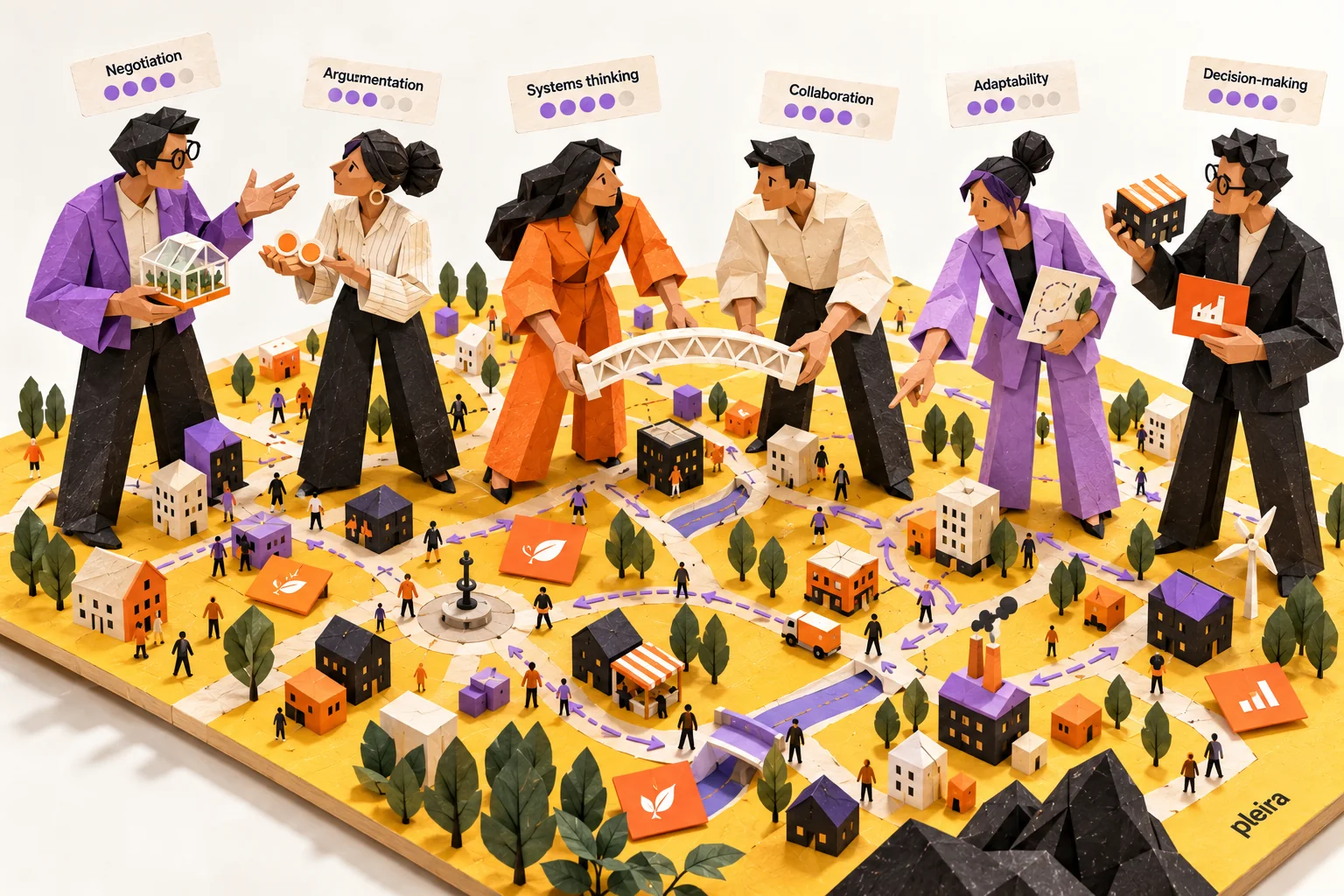
Paper figures of six students stand around a yellow game board of a small town with shops, factories and roads. Above each student floats a card with a skill, such as negotiation, systems thinking or decision-making, rated with violet dots.

From your learning goals to evidence of what each student can do.

Pleira is a multiplayer business simulation for business and management schools. Students run competing companies in a live market played by AI agents. You score each one against your programme's goals, with moments from the game behind every level.

Round 3 of 6Market log, illustrativeLive session, illustrative · 06:40 left

    Pleira is at pilot stage. Format, length and reporting are agreed with each school in the pilot.

    Essays show what AI can write.

    A live market simulation shows what a student can do.

    Accreditors still want evidence for every student, and employers trust skills tests more than master's degrees. Pleira gives you that evidence: students act, rivals answer back, and every score points to what someone actually did.

    How a session runs

    Everything happens live on the Pleira platform, so every move and message is on record. A typical session takes about three hours: three rounds of about 40 minutes. Length is set with you.

    Before classThe instructor

    • Pick a game

      One of 50 games based on real-world business situations, or one built for your course.

    • Set the criteria

      Your learning goals and your scale, each tied to what students can show in the game.

    • Students join online

      From any device, together in one room or apart.

    See how it fits your curriculum

    During the sessionAbout 3 hours · 3 rounds of about 40 minutes

    AI market

    Customers, suppliers, investors and regulators are AI agents. They bargain, hold back information and push back on every move.

    Students

    Alone or in teams, students run competing companies and negotiate with each other in real time. There is no menu of answers.

    Both at once. Example: City Mobility, Team Orange

    AI marketThe regulator agent drafts a parking levy. The battery supplier agent raises prices by 12%.

    The move in the student recordStudentsOrange moves 30% of its fleet to electric cars and switches supplier. Elena accepts the new supplier's first offer of 3% against her own target of 8%.

    Round closesThe market recalculates from every moveThe next round starts from the results

    AfterBefore the next class

    • The instructor scores

      Each student on your published criteria, with the episode behind every level. The AI does not score.

    • Debrief pack

      Turning points, the riskiest strategies and questions for discussion.

    • Records and reports

      A record for every student and a report for the cohort.

    See the documents

    Every student leaves with feedback on what they can improve.

    One session gives three documents from the same log: a record and a private report for the student, a scoring screen for the instructor, a cohort report for the dean.

    Marked in every view: in round 2, Elena accepted the supplier agent's first offer of 3% against her own target of 8%.

    Student record

    Elena Marchetti · MSc Management
    Strategy module, session 2 of 3 · 14 November 2026
    City Mobility · CEO, SwiftShare, Team Orange

    Synthetic sample
    Record ID PLR-26-0414
    Scored by Dr A. Novak, module lead

    1 Not yet2 Developing3 Proficient4 StrongThe level is the instructor's judgement on the whole session, not an average of rounds.

    Decision-making under pressure

    Learning goal 2 · Analyse and decide

    Proficient

    • R2Spotted the regulator agent's draft parking levy before the vote and proposed moving 30% of the fleet to electric cars. The team adopted it; the team result went from −200 after round 1 to +412.
    • R1Held prices while two rivals cut theirs by 10% and lost 18% of rides; the trade-off was not discussed with the team.

    Adaptability

    Learning goal 2 · Analyse and decide

    Proficient

    • R3When the city capped car numbers, redesigned the offer around e-scooters within the same round, with prices, fleet size and break-even worked out.
    • R2Switched battery supplier after a 12% price rise.

    Negotiation

    Learning goal 3 · Lead and influence

    Developing

    • R2The same moveAsked the new supplier agent for a volume discount once and accepted its first counter-offer of 3%; her own plan had set 8% as the target.
    • R3Pitched the e-scooter launch to her team with full numbers but did not answer the finance lead's question on payback. The team declined to fund it.

    Collaboration

    Learning goal 4 · Work across teams and functions

    Developing

    • R1Did not speak in the team's planning discussion; carried out the pricing task the team lead assigned.
    • R3Team Black offered to co-invest; the offer lapsed without a reply.

    How it was scoredThe software pulls episodes for each student from the session log. The instructor reviews them and sets every level against published descriptors.

    What is not in itNo personality labels, no peer or self ratings, nothing read from faces or voices. The AI does not score students.

    Who owns itThe record belongs to the student, who decides whom to share it with. The school confirms it is genuine under the record ID.
    Synthetic data. Criteria, scale, descriptors and report formats are agreed with each school in the pilot.

    How Pleira fits into your curriculum.

    In one course, across a programme or as a single event. Scored on your criteria, with results in your LMS.

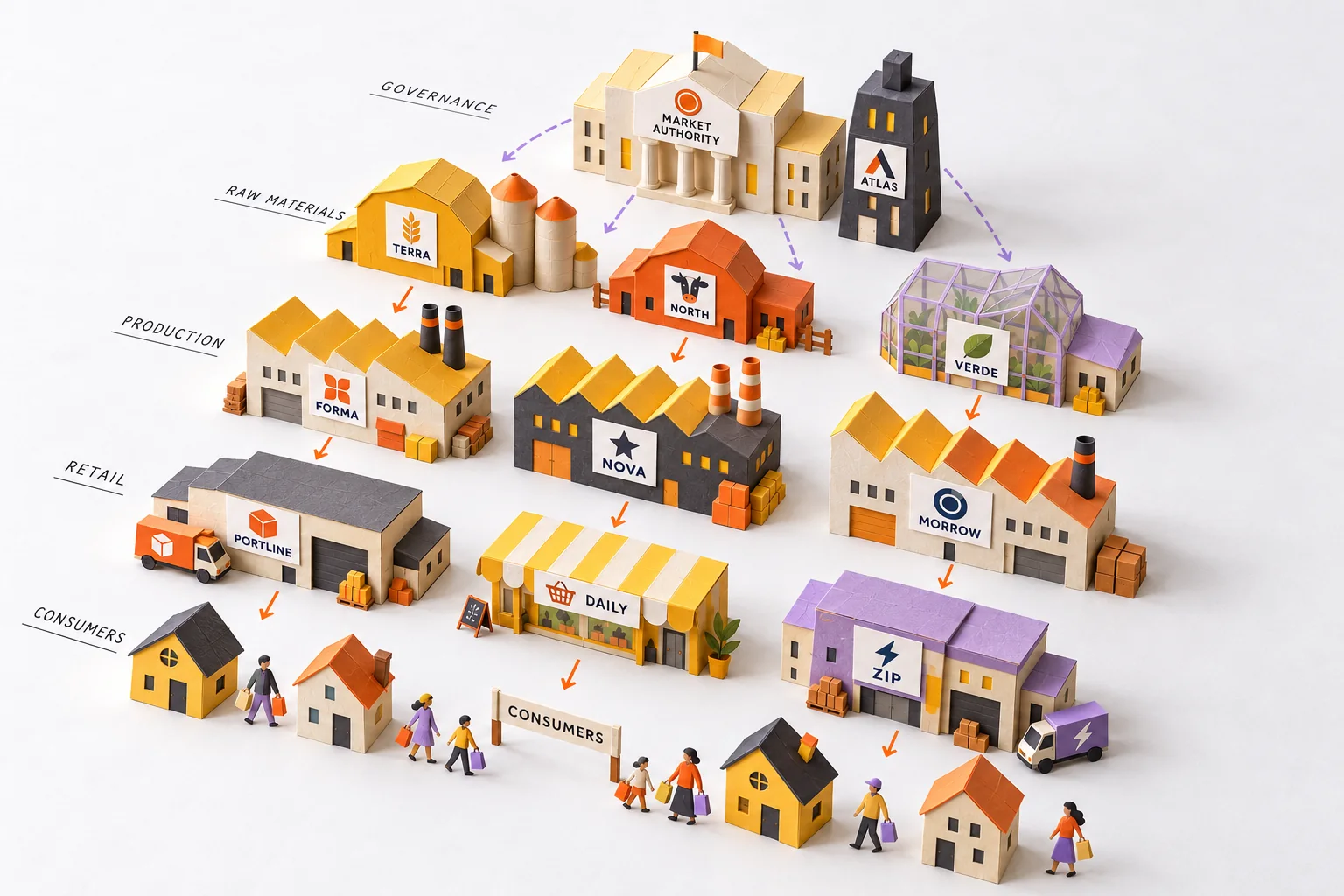
    A paper model of a market: a market authority and a bank at the top, farms supplying raw materials, three factories, a warehouse, a grocery and a delivery service, and households of consumers at the bottom, connected by arrows.

    In your programme

    Four formats, from one course to a whole programme.

    Across a module

    Inside a course

    Several rounds across a module, next to the cases you already teach. No syllabus redesign: the AI runs the market and prepares the debrief.

    At a milestone

    Inside a programme

    A game at a programme milestone, such as the start of a term or the capstone, scored on the programme's learning goals rather than one course's. Short programmes for working professionals included.

    One day

    Assessment day

    One day built around one live game, ending with an individual record for every student.

    First week

    Induction week

    New students play together in their first week. They meet their cohort, and you see where each of them starts.

    With your game and your criteria

    Start from a ready game or fit one to your course. Score it on your framework, not ours.

    The game

    One of 50 games based on real-world business situations, each with its market, AI agents and scoring guide. Or a game our team builds with the instructor around the industry, profession and cases your course needs.

    Your criteria and your scale

    Bring your competency framework, rubric and grading scale, or start from ours. Each criterion is mapped to a programme learning goal, so results line up with your assurance of learning reports.

    In your systems

    Results go where your school keeps them.

    LTI 1.3. Instructors add a game to their course in Moodle, Canvas, Brightspace or Blackboard Learn, and students launch it without a separate login. The class list comes from the LMS, and scores for each criterion go back to its gradebook through LTI Advantage services.

    xAPI. Session events, such as moves, deals and the levels set by the instructor, are sent as xAPI statements to your Learning Record Store, whether it stands alone or is built into your LMS.

    What stays the same

    Every game runs live on the Pleira platform, with all students playing at the same time. They can sit in one classroom or join from anywhere, on a laptop, tablet or phone. Playing on the platform is what puts every move on record.

    Game length and the number of classes are set with you. Already run Capsim or a textbook simulation? Pleira can sit next to it as a module on leadership and negotiation.

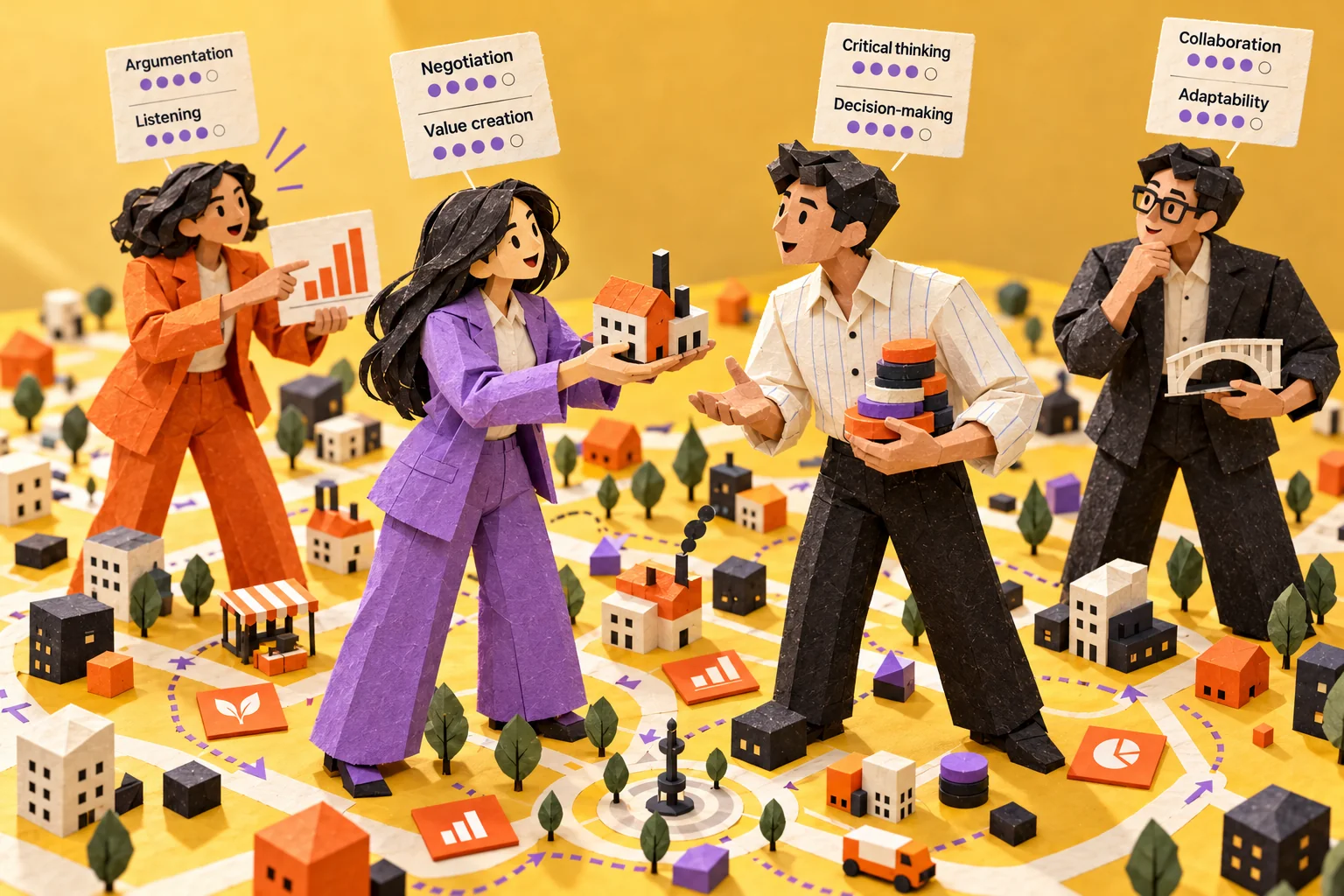
    Four paper students on a warm yellow board hand each other a small factory and stacks of tokens, with skill cards for argumentation, negotiation, critical thinking and collaboration above them.

    Start with one course and one instructor.

    A pilot is sized to show results within a semester, so they arrive while the people who asked for them are still in post.

    1. We choose a course with an instructor who already wants to change how they assess.
    2. We build the game around that course and agree the criteria with its learning goals.
    3. Students play one or more sessions during the semester.
    4. You get individual records, the debriefs, and a first draft of the accreditation format.
    Request a pilot

    Questions schools ask

    Can students use ChatGPT during a session?

    They can open it, but there is little for it to answer. The market shifts with every rival move, and the negotiations happen live with classmates and agents. The grade rests on what the student did in the session, not on a text they hand in.

    Does the AI grade students?

    No. The AI plays the customers, suppliers and investors and prepares the debrief. The instructor scores each student against published criteria, and every score points to an action in the game.

    Won't students find a hole in the model and share it?

    That is a real risk with any simulation. The game economy is balanced by running it as a simulation before a session, not by eye. Pleira has not yet been played by full student cohorts, and the pilot is where we test that.

    How much instructor time does it take?

    The aim is no course redesign and a debrief that is ready before class. Scoring has to take minutes, not evenings; the scoring screen is shaped with your instructor during the pilot.

    Can students play in the classroom?

    Yes. Every session runs live on the Pleira platform, so students need a browser and a connection, not a particular place: they can sit in one room or join from anywhere, on a laptop, tablet or phone. Everyone plays at the same time, so cohorts spread across time zones need a shared slot.

    Does it connect to Moodle, Canvas or Blackboard?

    Yes, through LTI 1.3. Instructors add a game from the LMS, students launch it without a separate login, and scores go back to the gradebook. Session events can also be sent as xAPI statements to your Learning Record Store. A WCAG 2.1 AA accessibility review is on the roadmap.

    What happens to student data?

    We keep what the scoring needs: moves and messages from the session, stored in the EU. We are working to pseudonymise them wherever scoring does not need a name. Students can see their data under GDPR, nothing is read from faces or voices, and student data is not used to train commercial AI models. We put this in the pilot agreement.

    What does it cost?

    Pilot terms are agreed with each school. Pricing for courses inside degree programmes and for short programmes is likely to differ, and we set it with the first schools.

    Request a pilot

    Tell us which course or programme you have in mind. We reply within two working days to set up a first conversation.

    We use these details only to reply to you.